 Ultimate guide
Student Violins: A Complete Buying Guide
Table of Contents
- Essential Features to Look for in Student Violins
- Violin Sizing Guide for Students
- Renting vs Buying a Violin
- Essential Violin Accessories for Beginners
- Price Points and Budget Guidance
- Common Mistakes to Avoid When Choosing a Student Violin
- How to Test a Student Violin Before Committing
- Frequently Asked Questions
Last Updated: October 4, 2026
Essential Features to Look for in Student Violins
When selecting a student violin, understanding what separates a playable instrument from one that will frustrate a beginner is crucial.
A student violin should have a responsive, consistent tone across all four strings and a neck that feels comfortable under the fingers. The instrument needs to stay in tune reasonably well and respond quickly when the bow makes contact with the strings.
Wood quality and construction
The wood used in a student violin directly affects both durability and sound. Look for instruments made from solid spruce for the top and solid maple for the back and sides.
The varnish finish matters too. A proper varnish protects the wood and contributes to the instrument's tone. Cheap finishes crack easily and don't age well, whereas quality varnish can last decades with proper care.
The scroll and pegbox should show careful craftsmanship.
Setup and playability
Setup is where many budget student violins disappoint. The bridge must be perfectly straight and positioned correctly, the strings must be at the right height, and the soundpost inside the violin must be properly fitted.
Check the fingerboard for straightness by sighting along it from the pegbox. A warped fingerboard makes intonation nearly impossible.
When you hold the violin, the chinrest should feel natural under your chin, and the shoulder rest (if used) should sit stably without slipping.
Violin Sizing Guide for Students
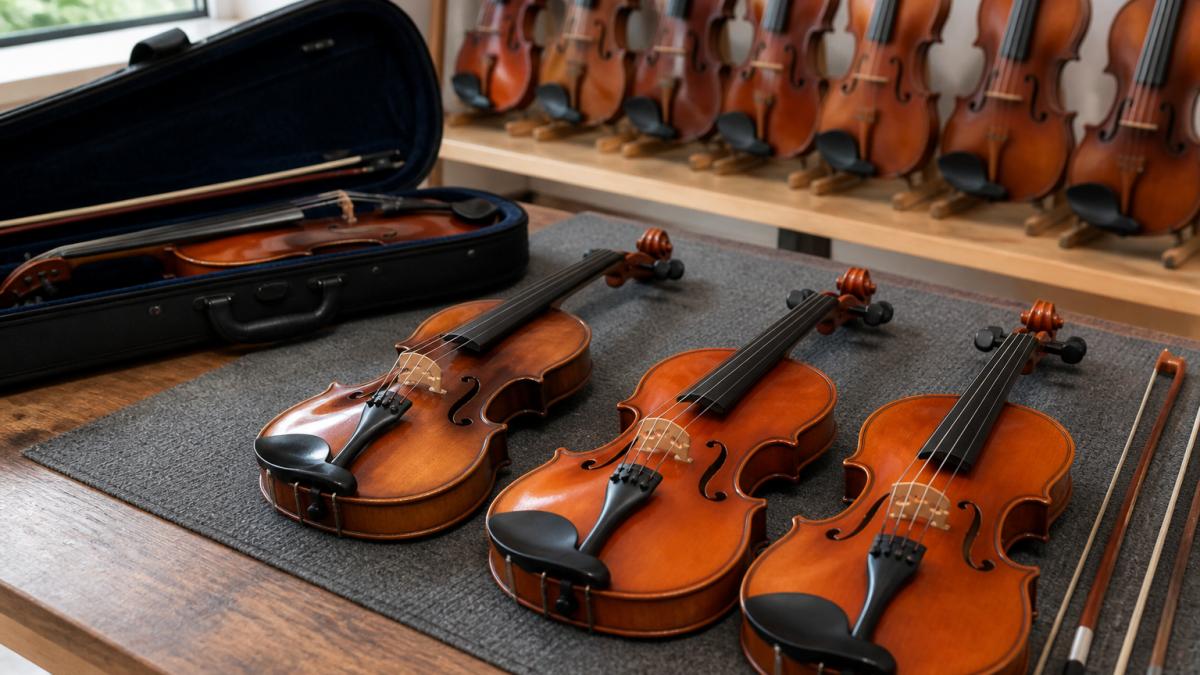
Choosing the correct size is non-negotiable. A violin that's too large will be exhausting to hold and nearly impossible to play properly, whilst one that's too small will become outgrown within months and limit technique development.
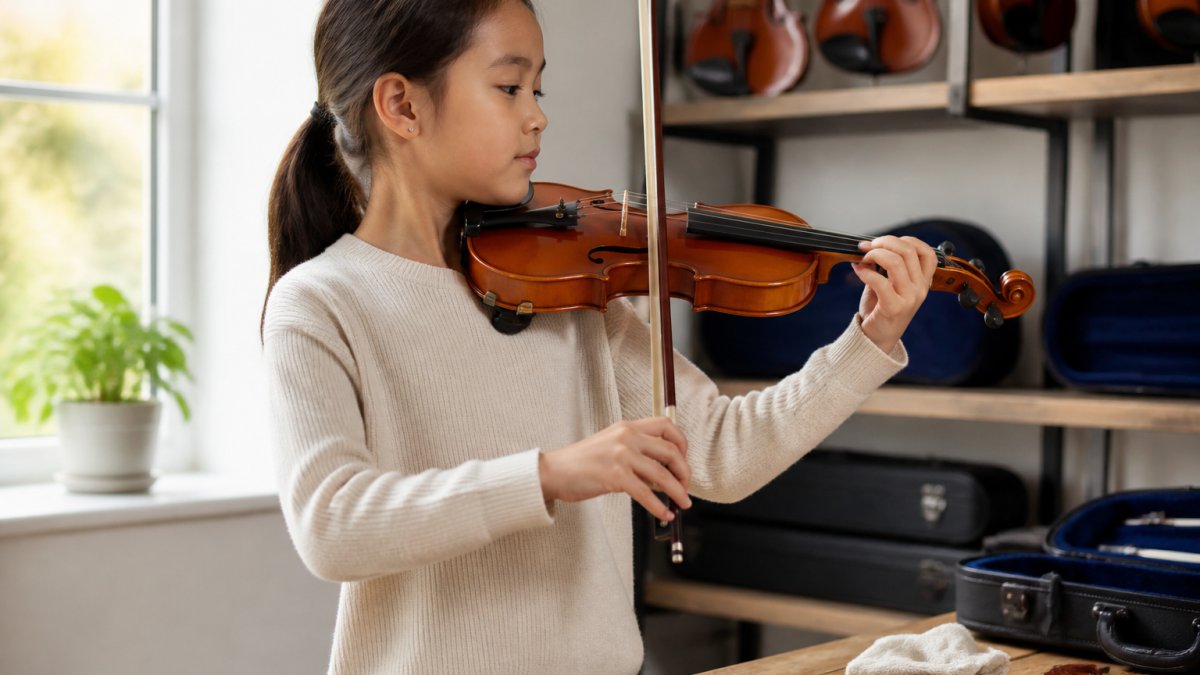
Measuring for the correct size
The standard method is to measure from the student's neck to the tip of their outstretched fingers on the left arm.
A 1/2 size violin typically suits children aged 4-7 with an arm span of 45-55 cm. A 3/4 size works for ages 7-10 (55-65 cm).
Have the student hold the violin in playing position and check that they can comfortably reach the end of the fingerboard with their left hand whilst maintaining good posture.
Growth considerations and sizing up
A common mistake is buying a violin that's "close enough" with the expectation the student will grow into it. This rarely works. An oversized violin causes poor technique development because the student compensates by hunching or reaching awkwardly.
It's better to buy the correct size now and upgrade when the student genuinely outgrows it, typically after 18-24 months of regular practice.
Renting vs Buying a Violin
This decision often comes down to commitment level, budget, and how certain you are that the student will continue playing. Both options have genuine advantages.
When renting makes sense
Renting is sensible if you're uncertain whether your child will stick with music lessons.
Rental agreements typically include maintenance and repairs, which removes the worry of damage costs. If a string breaks or the bridge cracks, the rental company handles it.
Rental instruments are often refreshed regularly, meaning you're not stuck with an ageing violin that's accumulated wear and damage. The rental company keeps instruments in playable condition, which matters more than you might think.
When buying is the better choice
Once a student has been playing consistently for 6-12 months and clearly enjoys it, buying becomes more economical.
Owned instruments develop character and familiarity. A student becomes accustomed to their violin's particular quirks and sound, which supports musical development. There's also a psychological factor: owning an instrument often increases motivation and practice consistency.
If you're purchasing, buy from a retailer who can ensure proper setup and offer after-sales support.
Essential Violin Accessories for Beginners
The violin itself is only part of the equation. Several accessories are essential for playability and maintenance.
Bows and rosin
The bow is arguably as important as the violin itself. A cheap, poorly balanced bow makes playing exhausting and limits tone production. Student bows should be made from reasonably straight wood with good hair tension and balance.
Rosin is non-negotiable, it's what allows the bow hair to grip the strings and produce sound. Without it, you'll draw a silent stick across the strings. Natural rosin works well for most students.
Cases and protection
A proper case protects your investment. Hard cases offer maximum protection and are worth the extra cost if the violin will be transported regularly. Soft cases are lighter and easier to carry but offer less protection if dropped.
Inside the case, you'll want secure compartments for the bow, rosin, and a shoulder rest. A humidifier is essential in dry climates or centrally heated homes, wood expands and contracts with humidity changes, and maintaining 40-60% humidity prevents cracks and warping.
Maintenance and tuning tools
A fine tuner on the tailpiece makes small adjustments easier than using pegs alone.
A shoulder rest prevents the violin from slipping and reduces neck and shoulder strain. Chin rests come in various shapes, experiment to find one that feels natural.
A rosin cloth or soft cloth is essential for wiping down the violin after practice to remove rosin dust. Never use water on the wood, it damages the varnish.
Price Points and Budget Guidance
Entry-level instruments (typically the most affordable options) are fine for absolute beginners in their first few months.
Mid-range student violins offer a significant step up in materials, construction, and sound quality.
Higher-end student violins approach intermediate-level quality and suit dedicated students who've been playing for a year or more and show serious commitment.
Rather than focusing on a specific price, think about value.
Common Mistakes to Avoid When Choosing a Student Violin
Several predictable errors can derail your purchase decision. Knowing what to avoid saves time and money.
Prioritising appearance over quality
A beautiful-looking violin with poor playability will discourage any student. Appearance matters far less than how the instrument feels and sounds. A plain, well-made violin will support learning far better than an ornate one that's frustrating to play.
Some budget instruments are designed to look impressive in photos but cut corners on wood quality and setup. Resist the temptation to choose based on colour or decorative details.
Ignoring proper setup
This mistake costs more than it saves. Buying a cheap violin and skipping professional setup leaves you with an unplayable instrument. Setup transforms a mediocre violin into something functional.
Never assume an instrument is ready to play straight from the box. Even mid-range violins benefit from a technician's attention to bridge placement, string height, and soundpost positioning.
Overlooking after-sales support
Buying from an online marketplace or an unfamiliar retailer might save money upfront, but it leaves you without recourse if something goes wrong. A reputable retailer offers setup support, can address problems quickly, and provides guidance if the instrument isn't right for your student.
If a violin arrives and doesn't feel right, you need a retailer who'll help troubleshoot or arrange a replacement. This support is worth more than a small price difference.
How to Test a Student Violin Before Committing
Play or have a teacher play a simple scale on the instrument.
Hold the violin and check the weight distribution. It should sit naturally under your chin without feeling top-heavy or requiring constant adjustment.
Bow the open strings with a full, slow stroke.
If you're buying online or unable to try the instrument first, purchase from a retailer who allows returns or exchanges.
Choosing a student violin requires balancing several factors: wood quality, proper sizing, playability, and reliable after-sales support.
Hayes Music helps musicians at every level find instruments that support their development. Our showroom in Hampshire gives you the chance to see and play instruments before committing, and our repair and maintenance services ensure your violin stays in playable condition throughout your student's musical journey.
Frequently Asked Questions
What size violin do I need for a beginner?
Violin sizes range from 1/32 to full size (4/4). Most children aged 4-6 start with 1/4 or 1/2 size, whilst older children and adults typically use 3/4 or 4/4. Measure from the student's neck to the palm of their outstretched left arm; this measurement in centimetres helps determine the correct size. A properly sized violin allows the player to comfortably reach the scroll and maintain good posture. Many beginners outgrow their first instrument within 1-2 years, so consider rental options if growth is expected.
Should I rent or buy a student violin?
Renting works well if you're unsure about long-term commitment, expecting rapid growth, or wanting to avoid a large upfront investment. Buying makes sense if the student is committed, has completed a trial period, or is older and unlikely to outgrow the instrument quickly. Rental agreements often include maintenance and repairs, reducing unexpected costs. However, ownership builds investment in the instrument and allows customisation. Many families rent initially, then purchase once they're confident the student will continue learning.
What are the signs of a poor-quality student violin?
Poor-quality student violins often have uneven wood, rough finishes, or misaligned seams. The bridge may be poorly fitted or warped, and the strings may sit too high or too low. Cheap instruments produce a thin, scratchy tone that discourages practice. The bow may be warped or have loose hair, making it difficult to produce consistent sound. Setup issues are common in budget instruments, and they may require immediate adjustment. Reputable retailers inspect instruments before sale, ensuring they're playable straight out of the box.
Do student violins come with bows and cases?
Many student violin packages include a bow and case, but quality varies significantly. Entry-level bows may be poorly balanced or have loose hair, affecting playability. Hard cases provide better protection than soft cases, especially during transport. Some retailers sell instruments without accessories, allowing you to choose components separately. Quality bows and protective cases are essential investments; a poor-quality bow frustrates beginners and hinders learning. Always check what's included in a package before purchasing, and consider upgrading accessories if they're substandard.
How much should I spend on a first violin?
Budget depends on your situation. Entry-level student violins offer reasonable quality for complete beginners, whilst mid-range instruments provide better sound and durability for committed learners. Avoid extremely cheap instruments, as they often require expensive repairs and discourage practice. Consider the total cost of ownership, including case, bow, rosin, and maintenance. If renting, monthly costs accumulate, so calculate whether buying becomes more economical long-term. Retailers can advise on value at different price points and help you find an instrument suited to your budget and goals.
Is it better to buy a new or second-hand student violin?
New student violins from reputable retailers come with guarantees and are pre-inspected for playability. Second-hand instruments may offer better value but require careful assessment; internal cracks, damage, or poor setup aren't always visible. Purchasing second-hand from a specialist retailer with a warranty is safer than private sales. New instruments allow you to choose exactly what you want and receive proper setup. If buying second-hand, have a professional inspect it first. Many beginners benefit from new instruments with clear warranty support and reliable after-sales service.
What makes a student violin different from a professional violin?
Student violins prioritise affordability and durability over premium tone quality. They're typically made with less expensive woods and simpler varnish, but still produce adequate sound for learning. Professional violins use higher-grade materials, superior craftsmanship, and decades of ageing, resulting in richer tone and better projection. Student instruments are designed to withstand the wear of learning, with forgiving playability and lower replacement costs if damaged. As players advance, they transition to better instruments that reward improved technique with superior sound. Starting on a student violin is appropriate; upgrading comes naturally as skills develop.