 blog
Starter Instrument Kits for Schools: What to Buy and Why
Table of Contents
- What a Starter Instrument Kit for Schools Contains
- Choosing Classroom Musical Instrument Sets by Key Stage
- Early Years Music Instruments: Suitability for Nursery and Reception
- Percussion Sets for Schools: Side-by-Side Kit Comparison
- School Music Equipment Buying Guide: Budget, Durability and Storage
- Accessible and Inclusive Adaptations for Whole-Class Use
- Booking Your Classroom Kit Order With Hayes Music
- Frequently Asked Questions
Last Updated: 5 November 2026
What a Starter Instrument Kit for Schools Contains
This guide sets out what teachers, parents and music coordinators can expect to find in a typical starter instrument kit for schools before they buy. A starter instrument kit is a pre-selected group of simple, durable instruments sold together, usually packed into a basket or carry bag, designed for shared use by a class or group.
Kits differ widely in size and price, and the honest answer to "what should we buy?" depends on how the instruments will be used. A kit built for early years rhythm games looks very different from one designed for a Year 5 ensemble.
Typical Instrument Count and Kit Contents
Kit sizes vary by supplier and by the number of pupils the kit is meant to serve, so check the instrument count against your own class size.
Pricing depends on quantity, the instruments included, delivery terms and the number of pupils you are equipping. For current prices and a quote for your school, please visit the Hayes Music website or contact the team directly.
Watch out: a kit that looks generous on paper can still leave pupils waiting for a turn if it has too few of the instruments that get used most. Count the items that will be in constant demand, such as shakers and tambourines, rather than the total.
Percussion Instruments Most Kits Include
Percussion makes up the core of most starter kits because it is strong, easy to pick up and needs no tuning. Common items include egg shakers, maracas, tambourines, claves, small hand drums, triangles and cowbells. Many kits also include a xylophone or glockenspiel, which introduces pitch and melody alongside rhythm.
When you review a kit, look at how each item is made. Solid, well-finished instruments tend to survive a busy classroom far better than thin, lightweight alternatives.
Choosing Classroom Musical Instrument Sets by Key Stage
Choosing the right set starts with the age group it will serve.
For Key Stage 1, look for lightweight, large-grip instruments that small hands can control. For Key Stage 2, a broader mix of percussion and a pitched instrument such as a xylophone gives pupils more to explore in group work.
Our advice is to decide the learning objective first, then choose the kit that delivers it. Ask whether the lessons focus on rhythm, pitch, listening or performance, and let that guide your selection.
Early Years Music Instruments: Suitability for Nursery and Reception
Early years settings need instruments that are safe, simple and forgiving. Children at nursery and Reception age explore by shaking, tapping and mouthing objects, so anything used should be free of small parts that could come loose and be swallowed.
Good early years choices include egg shakers, scarves for movement work, bells and simple hand drums. These support rhythm and movement activities, language development and early listening skills. Short, repeated games with a small set of instruments can help hold young children's attention.
Be cautious with instruments that have sharp edges, loose beaters or detachable parts. A quick check before each session is good practice in any early years setting.
Percussion Sets for Schools: Side-by-Side Kit Comparison
Most suppliers list percussion sets as separate product pages, which makes it hard to see how they differ. Rather than repeat a blank table, this section sets out the comparison method we recommend and the trade-offs that actually matter when you line kits up against each other.
Compare on these six criteria, in this order
- Instrument count versus class size. Divide the instrument count by your largest class. A 30-piece kit for a class of 30 gives one instrument per pupil; a 20-piece kit for the same class means ten pupils wait or share. Count the high-demand items (shakers, tambourines, claves) separately, because these are the ones that cause turn-taking bottlenecks.
- Key stage fit. Check the supplier's stated age range and whether the grips, beaters and instrument sizes suit the hands that will use them. A kit labelled for early years will usually have larger, lighter grips; a Key Stage 2 kit will include smaller beaters and a pitched instrument.
- Pitched versus unpitched balance. Rhythm-only kits are cheaper and simpler; kits with a glockenspiel or xylophone unlock pitch, melody and listening work. Decide whether your scheme of work needs pitched instruments before comparing prices.
- Storage and portability. A basket or carry bag that fits a cupboard is easier to manage than loose instruments. Check whether the storage is included in the price or sold separately, and whether it is sturdy enough for daily handling.
- Replenishment and spares. Ask whether individual instruments and beaters can be bought separately. A kit you cannot top up becomes a kit you replace.
- Cost per pupil over the kit's life. Divide the total price by the number of pupils it serves, then divide again by the number of years you expect it to last. This is the figure to compare, not the headline price.
A worked comparison approach
Take three kits you are considering and score each one out of five on the six criteria above, weighting cost per pupil and key stage fit most heavily. A kit that scores well on instrument count but poorly on replenishment will usually cost more over three years than a slightly smaller kit with available spares. Sturdier instruments with replaceable beaters often last longer than cheaper sets, even when the upfront price is higher.
What separates a general percussion pack from a whole-class kit
A general percussion pack is usually a mixed selection for group work and exploration. A whole-class kit is planned around one instrument per pupil and tends to include more of the high-demand items plus a storage solution.
Watch out: a kit described as "whole class" may still assume sharing for larger classes, so check the stated pupil number against your own register before ordering.
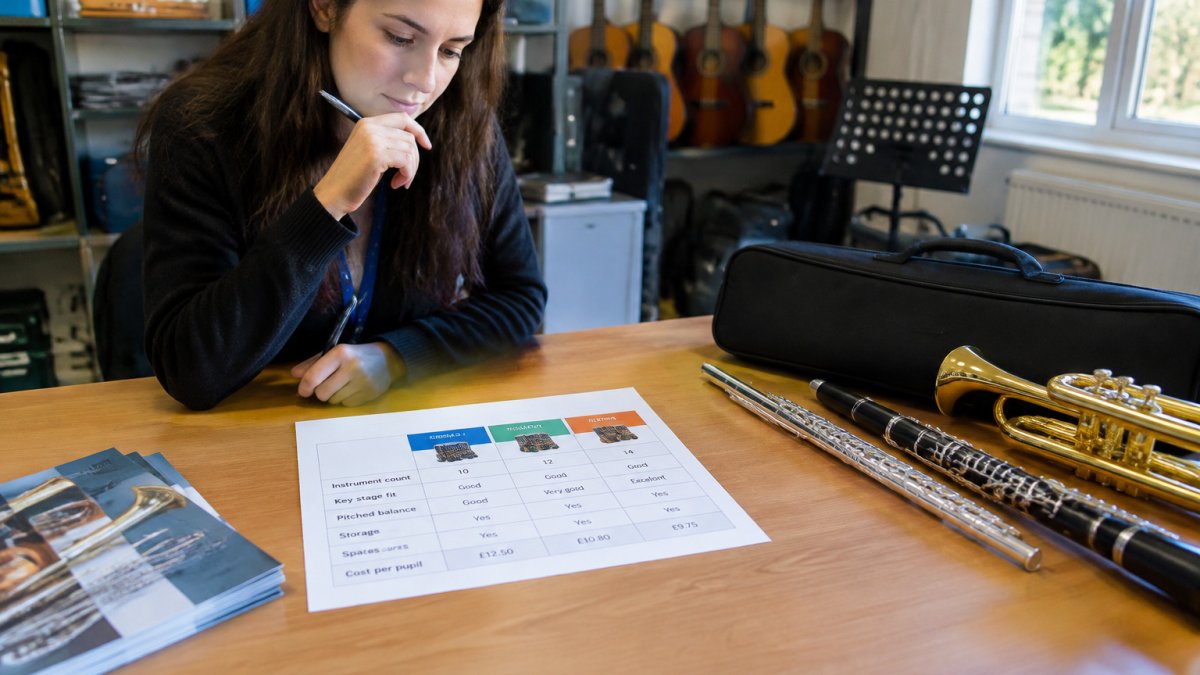
The six criteria below set out what to compare when lining kits up against each other.
| Criterion | What to check | Why it matters |
|---|---|---|
| Instrument count versus class size | Divide instrument count by largest class | Shows whether pupils wait or share |
| Key stage fit | Stated age range and grip or beater sizes | Suits the hands that will use them |
| Pitched versus unpitched balance | Whether glockenspiel or xylophone is included | Unlocks pitch and melody work |
| Storage and portability | Whether basket or bag is included and sturdy | Makes daily handling manageable |
| Replenishment and spares | Whether individual items can be bought separately | A kit you cannot top up gets replaced |
| Cost per pupil over kit life | Total price divided by pupils and years | The true figure to compare |
School Music Equipment Buying Guide: Budget, Durability and Storage
Budget, durability and storage are where most school kit purchases succeed or fail, yet they are the least covered topics in most buying guides. This section gives you the practical mechanics.
Work out cost per pupil, not headline price
The headline price tells you little. Use this calculation instead:
Cost per pupil = total kit price ÷ number of pupils served ÷ expected years of service
For example, a kit costing £300 that serves 30 pupils for three years works out at roughly £3.33 per pupil per year. A cheaper £180 kit that serves 20 pupils and lasts one year works out at £9 per pupil per year. The cheaper kit is the more expensive choice. Ask suppliers for the instrument count, the stated pupil number and the warranty period so you can run this sum before you buy.
Materials and construction: what to check
- Wood (claves, woodblocks, xylophone bars): warm tone and good resonance, but vulnerable to splitting if dropped or stored damp. Check for smooth, sealed finishes.
- Metal (triangles, cowbells, glockenspiel bars): durable and bright, but check fixings and edges for sharpness, and confirm beaters are the correct type to avoid denting.
- Hard plastic (shakers, tambourines): the most forgiving for daily classroom use, but thin mouldings crack. Look for solid seams and secure rims.
- Drum skins: check whether heads are replaceable and whether the supplier stocks spares.
In every case, check that beaters and mallets are matched to the instrument. Using a hard beater on a glockenspiel or xylophone dents the bars, and mismatched beaters are one of the most common causes of premature wear.
Storage that protects the kit
A sturdy basket or cabinet keeps instruments together, makes inventory checks quick and reduces loss. Store instruments dry and away from radiators, because wood and drum skins react badly to heat and damp. Keep beaters in a labelled container so they are not lost between lessons, and assign a pupil or staff member to check the kit in and out. A simple inventory list on the inside of the storage lid makes missing items obvious at a glance.
Maintenance and replacement planning
Plan for wear from the start. Budget a small annual sum for replacement beaters, shakers and drum heads, and confirm before purchase that individual items can be bought separately. Check instruments before each half-term for loose fixings, split wood, cracked plastic and worn drum heads, and remove anything damaged from classroom use until it is repaired or replaced. Regular checks and a stocked spares cupboard can help keep a kit playable for longer.
Watch out: buying a kit with no available spares is the most common budget mistake, because a single broken high-demand instrument can make the whole set unusable for whole-class work.
Guidance on instrument safety and age suitability from the supplier's product information
Accessible and Inclusive Adaptations for Whole-Class Use
Whole-class music should work for every pupil, including those with physical, sensory or learning needs. Lightweight instruments, large grips and brightly coloured designs can help children with limited hand strength or visual differences.
Adaptations can be simple. Options such as mounting a tambourine on a stand, using instruments with extra grip, or pairing pupils to share a larger instrument can widen access. Many teachers also find that offering a choice of instrument helps pupils feel more included.
Speak to your school's SENCO when planning, so that instrument choices suit the particular needs in your class.
Booking Your Classroom Kit Order With Hayes Music
If you are ready to choose a kit, Hayes Music can help you compare options and plan an order that fits your class size, key stage and budget. Our showroom in Hampshire gives you the chance to see and handle instruments before you buy, and there is a free on-site car park.
Pricing for school orders depends on quantity, the instruments chosen and delivery terms, so please get in touch for a quote tailored to your school. Visit the Hayes Music website to browse current kits and contact the team to arrange your order.
Frequently Asked Questions
What instruments should be included in a school starter kit?
A typical starter kit covers the main families a class will use together: shakers, tambourines, claves, a small hand drum, a triangle and a pair of cymbals or cowbells. Some sets also add a xylophone or glockenspiel for pitch work. Hayes Music can advise on which combination suits your year groups, and current prices depend on the number of pupils, the quantity ordered and delivery. Contact the team or check the website for an up-to-date quote.
Are classroom instrument kits suitable for whole-class lessons?
Yes, provided the kit contains enough instruments for every pupil or pairs of pupils to play at once. Many teachers find that a mix of percussion instruments lets a whole class take part in rhythm and movement activities without waiting for turns. Check the number of pieces against your class size before ordering, and consider whether storage in a portable basket will suit how often the set moves between rooms.
How can schools choose instruments for different age groups?
Early years pupils benefit from lightweight, easy-to-grip instruments with large, simple striking surfaces and no small parts that could be swallowed. Key Stage 2 pupils can handle more demanding instruments and begin to explore pitch on tuned percussion. When you buy, match the instrument to the learning objective for each year group, and ask whether the supplier can advise on age suitability for the specific items in a kit.
Can Hayes Music help schools in Hampshire choose a starter kit?
Yes. Schools and music educators can speak to the Hayes Music team about kit contents, quantities and suitability for their pupils. Visiting the showroom lets staff handle instruments before ordering, and the free on-site car park makes that easy. For current pricing on classroom sets, contact the store or check the website, as costs vary with order size and delivery.