 blog
blog
Best Percussion Brands for School Bands: 2026 Guide
Table of Contents
- What Makes a Percussion Brand Right for a School Band
- How to Compare Percussion Brands for Durability and Sound
- Essential Percussion Kit for School Bands
- How to Maintain School Percussion Equipment
- Budget, Mid-Range and Professional Percussion Brands Compared
- Choosing the Right Percussion Brands for Your School Band
- Conclusion
- Frequently Asked Questions
Last Updated: September 13, 2026
What Makes a Percussion Brand Right for a School Band
Choosing the best percussion brands for school bands comes down to three things: instruments that survive daily classroom use, tuning that holds through a full lesson, and a price point that won't strain a school's budget. Durability matters more than tone here. A beginner percussionist will drop sticks, overtighten drum heads, and knock a glockenspiel off a table at least once a term (ism.org).
The pattern is consistent. Brands built for education prioritise reinforced hardware, replaceable components, and consistent sizing across a product line so a school can buy one snare drum this year and match it next year. Brands built for the gigging professional often skip those practicalities.
That distinction shapes everything below. This guide covers how to assess percussion brands for durability and sound, what belongs in a starter kit, how to maintain school percussion equipment, and how budget, mid-range, and professional lines compare.
How to Compare Percussion Brands for Durability and Sound
Comparing percussion brands for schools means testing two things above all: how the hardware holds up under repeated assembly, and whether the instrument stays in tune across a rehearsal. Features that look impressive in a showroom often fail in a classroom.
Durability Checks That Matter in a Classroom
Check the hardware before anything else. Look for double-braced stands, welded rather than crimped joints, and tension rods that thread smoothly without cross-threading. On drums, examine the hoop and lug casings; these are the first components to fail when instruments are assembled and packed away weekly.
- Double-braced stands and reinforced bass drum spurs
- Replaceable heads and tension rods available as individual spares
- Glockenspiel and xylophone frames with solid end blocks, not glued joints
- Carry bags or cases included, since instruments travel between rooms
A common mistake is buying on sound alone. A drum that sounds superb but uses single-braced hardware will be wobbling by half term.
Sound Quality and Tuning Stability
Tuning stability separates education-grade percussion from instruments that need constant attention. A well-made snare or tom holds pitch through temperature changes in a school hall, where heating is inconsistent (pubmed.ncbi.nlm.nih.gov). Cheaper shells and thin hoops slip out of tune within a lesson.
For tuned percussion, check the bar mounting. Rubber-pinned bars stay in place; loosely fitted bars rattle and drift. Brands that supply replacement bars individually are far easier to maintain over a five-year lifespan.
Incorporated Society of Musicians guidance on instrument quality for schools
Essential Percussion Kit for School Bands
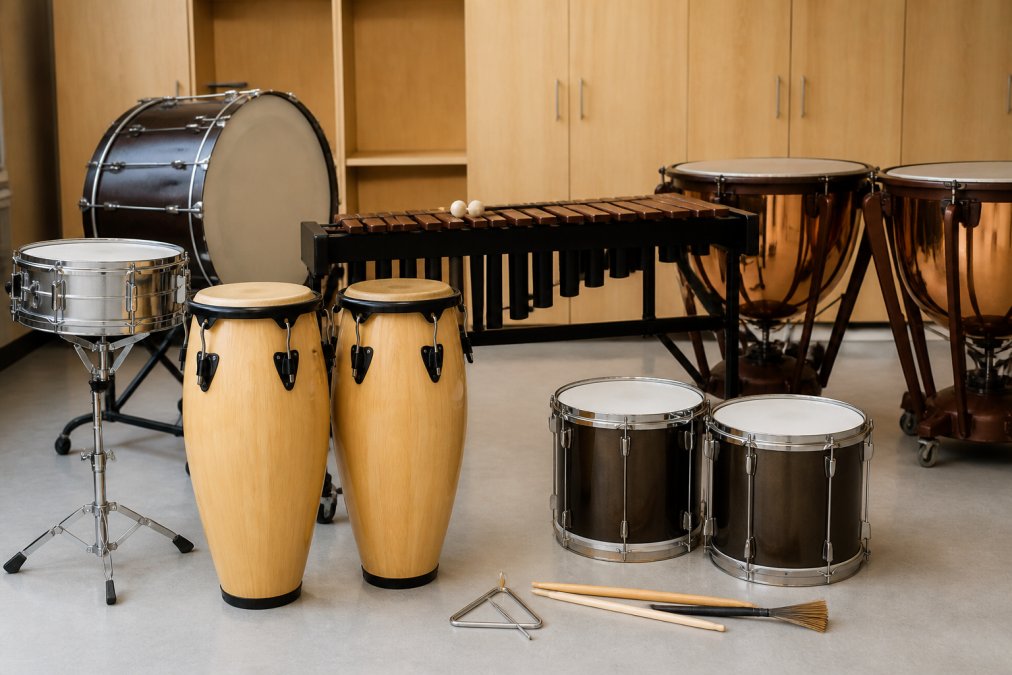
A complete school percussion setup covers rhythm, pitch, and texture. Most departments start with a core kit and add pieces as the ensemble grows, rather than buying everything at once.
The essentials break down into three groups. Untuned percussion provides the rhythmic backbone: a bass drum, snare drum, pair of cymbals, and a set of hand percussion such as tambourines, maracas, and claves. Tuned percussion adds melody: a glockenspiel is the standard first purchase, with a xylophone or chime bars added later. Accessories keep everything working: spare sticks, mallets, drum keys, and a tuning reference.
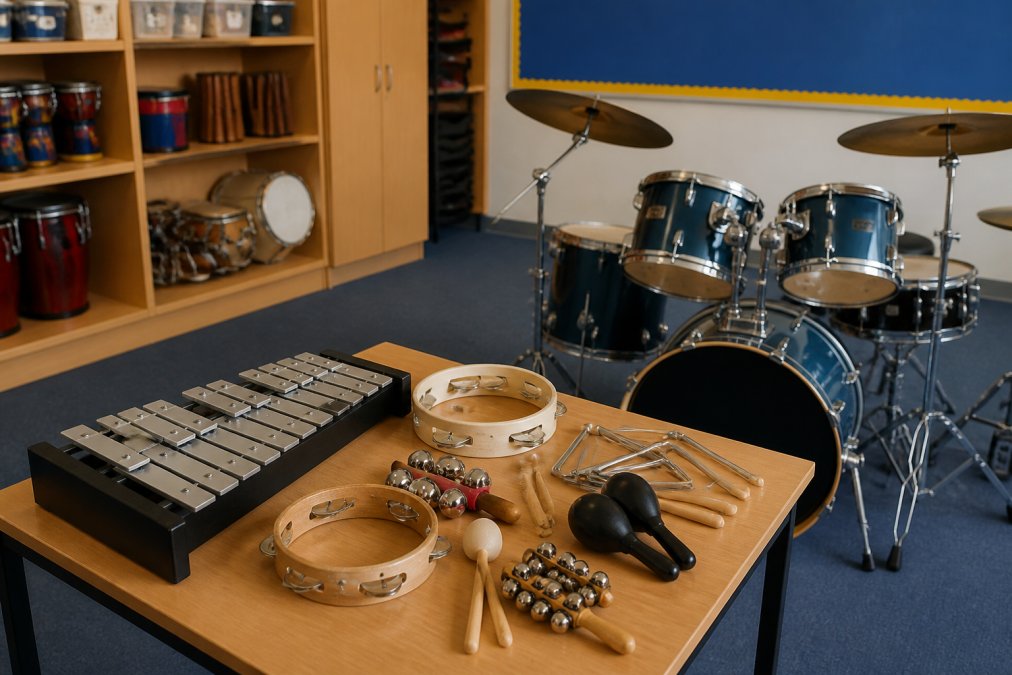
Buying in a single brand for the core kit simplifies maintenance, because spares and heads are interchangeable. Where a school mixes brands, mismatched tension rods and hoops become a recurring headache.
How to Maintain School Percussion Equipment
Maintaining school percussion equipment is mostly about routine. Instruments that are checked weekly last years longer than those inspected only when something breaks, and the checks themselves take minutes.
Daily and Weekly Checks
Wipe drum shells and hardware with a dry cloth after each use to remove hand oils and dust. Check tension rods for looseness weekly; a rod that keeps backing out signals a stripped thread and needs replacing before it damages the lug. Inspect glockenspiel and xylophone bars for cracks at the mounting pins.
- Wipe shells and hardware after every session
- Check all tension rods weekly for tightness
- Inspect drum heads for dents and uneven wear
- Confirm cymbal stands and bass drum spurs are stable
- Check tuned percussion bars for cracks and loose mountings
Longer-Term Care and Repairs
Every term, strip down drums to clean and lightly lubricate tension rods, and replace any head showing significant wear. Cymbal stands benefit from a check of the wing nuts and sleeves, which wear faster than the stand itself.
The thing nobody tells you about school percussion is that repair access matters as much as build quality. A drum that needs a specialist repair and sits in a cupboard for six weeks is worse than a cheaper instrument fixed locally in days. Hayes Music runs a full backup service and repair centre, so schools can keep instruments in rotation rather than out of action.
Budget, Mid-Range and Professional Percussion Brands Compared
Percussion brands fall into three broad tiers, and the right choice depends on how hard the instruments will be used and how long they need to last. The table below summarises the trade-offs without naming specific makers, since the priorities matter more than the badge.
| Tier | Typical Build | Best For | Watch Out For |
|---|---|---|---|
| Budget | Single-braced hardware, basic shells | Occasional use, first purchases | Hardware loosens quickly under daily use |
| Mid-range | Double-braced hardware, solid shells | Most school bands | Fewer spare parts stocked by some brands |
| Professional | Reinforced hardware, premium shells | Gigging ensembles, sixth forms | Higher cost, overkill for beginners |
Budget brands suit a primary school that plays percussion a few times a week. Mid-range is the sensible default for a secondary school band rehearsing daily. Professional lines make sense where an ensemble performs regularly and the instruments travel.
Choosing the Right Percussion Brands for Your School Band
The right percussion brands for your school band are the ones that match your rehearsal intensity, your maintenance capacity, and your repair access. Start with mid-range instruments for anything played daily, keep budget options for occasional pieces, and reserve professional lines for performance ensembles.
Three practical steps make the decision easier:
- Match the tier to how often the instrument is played, not to how it sounds in isolation
- Confirm spare parts and replacement heads are readily available
- Check that a local repair service can turn instruments around quickly
Visiting a showroom to test instruments before buying removes most of the guesswork. Hayes Music's showroom includes a dedicated practice room, so teachers and students can play before committing, and the team can advise on which tier suits a specific ensemble. With free on-site parking and a location near the M27, it is straightforward for a department to bring a group along and try several options side by side.
Conclusion
Equipping a school band is a long-term investment, and the brands that hold up are the ones built for repeated use, backed by spare parts, and supported by accessible repairs. Choosing on sound alone is the mistake that costs departments the most.
Hayes Music stocks beginner to professional percussion and offers a full repair centre, a dedicated practice room, and expert guidance to help you match instruments to your ensemble. Get started with Hayes Music and build a percussion setup that survives the school year.
Frequently Asked Questions
What are the most durable percussion brands for school use?
Look for brands that use reinforced lugs, double-braced hardware and replaceable heads. Check that spare parts, including tension rods and drum heads, are easy to order.
How do I choose the right percussion equipment for a primary school band?
Start with the essential percussion kit for school bands: a bass drum, snare, glockenspiel, tambourine, triangle, castanets and a set of beaters. For primary-age players, choose smaller drum sizes and lighter sticks so children can hold them comfortably. Prioritise instruments with rounded edges and no sharp metalwork. If you are unsure, visit a showroom where pupils can try the instruments before you commit, and ask staff to demonstrate tuning and basic maintenance.
Which percussion brands offer the best value for school music budgets?
Value comes from how long an instrument lasts, not just the purchase price. Mid-range brands often cost more upfront but need fewer replacements, which suits school budgets over several years. A brand with a strong spares network will save money on maintenance. Always request a quote for multiple instruments rather than buying one at a time.
How to maintain school percussion equipment for longevity?
Wipe drum shells and hardware with a dry cloth after each use, and check tension rods weekly for looseness. Replace drum heads when they lose tone or show dents, and store instruments in cases away from radiators. For glockenspiels, clean the bars with a soft cloth and avoid abrasive cleaners. Book an annual service with a repair centre to catch worn straps, cracked heads or bent stands early. Teaching pupils to handle instruments correctly is the single biggest factor in how long equipment lasts.